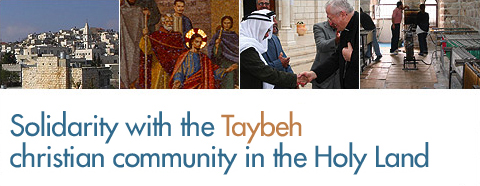
Industria Ceraria Migone cooperates in the development scheme for the Christian Community in the Holy Land - agreed on with the Latin Patriarch of Jerusalem - by importing and distributing candles and other handmade products manufactured in the Palestinian village of Taybeh .
Taybeh is ancient Ephraim, which is repeatedly spoken about in the Bible. It is the place mentioned in the Gospel of St. John when he relates that Jesus took refuge there after the synedrion's decision to put him to death: "So Jesus no longer went about openly among the Jews, but left the district for a town called Ephraim, in the country bordering on the desert, and stayed there with his disciples." (John 11:54). A powerful fortress designed to defend Jerusalem at the time of the Latin Kingdom , King Baldwin IV entrusted it to the Marquis William di Monferrato. After the defeat of the crusaders, Saladin changed its name into Taybeh, which means "good" in Arabic to specify that the village was inhabited by people who were not hostile.
In 1898 Father Charles de Foucauld retired to Taybeh at a time when he wanted to experience "the hidden humble life of the Holy Family of Nazareth". It is also the village in Ephraim, which, Maria Valtorta, the mystic, extensively mentioned.
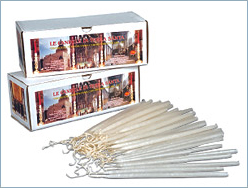
Having preserved its faith through the centuries, today Taybeh-Ephraim is the only fully Christian village in the Holy Land . It numbers ca. 1,500 inhabitants, while over 8,000 of its populace are scattered throughout the world due to the mass migration that began in the mid-1900s leading to a drop in the Christian presence in the Holy Land from over 20% to 1%. Marked by a very high rate of unemployment and the bleakest poverty, a peculiar "coincidence" made the Christian community in Taybeh-Ephraim the focus of the Florentine association Coltiviamo la Pace. The latter proposed and is still implementing a special overall development plan. Since 2003 the village of Taybeh-Ephraim has been twinned with the Archdiocese of Florence and, its Christian community was adopted by the Basilica of St. Lawrence parish in 2004. Hence the building of an industrial oil mill to optimise the century-old olive groves, a hospital and a centre for the disabled and the elderly who are not self-sufficient, besides a centre to promote products made by the Christian community in the Holy Land. The latter also comprises some handicraft workshops for the production of ceramic items (numbering the "Dove of Peace"), Besides, the community's youth make olive wood items, handmade candles and natural soaps.
 Hence the implementation of an effective fast-acting development scheme in Taybeh-Ephraim. Hence the implementation of an effective fast-acting development scheme in Taybeh-Ephraim.
Its products are by now exported to many countries and can also be purchased over the Internet. The village is now well known and is hence the target of many groups of pilgrims. It is especially admired and respected by the Muslim and Jewish communities in the Holy Land , which have found in it an example of a path to development and peace.
In his encyclical Populorum progressio Paul VI prophetically said that the path of peace moves through development. Industria Ceraria Migone follows this path by sustaining the production of the small workshop in Taybeh, which currently also ensures employment and proper wages to many families. The Company hopes to see this small wax factory develop further with the collaboration of those who are keenly interested both in the survival of our Christian roots in the Mother Church of Jerusalem and in peace in the Holy Land .
Project Coordinator, Coltiviamo la Pace Association
Prof. Giovanni Gianfrate
www.coltiviamolapace.com
E-mail: info@coltiviamolapace.com
OLIVE BRANCH FOUNDATION
Taybeh-Ramallah, Palestine
E-mail: peacelamp@lpj.org
www.taybeh.info
|